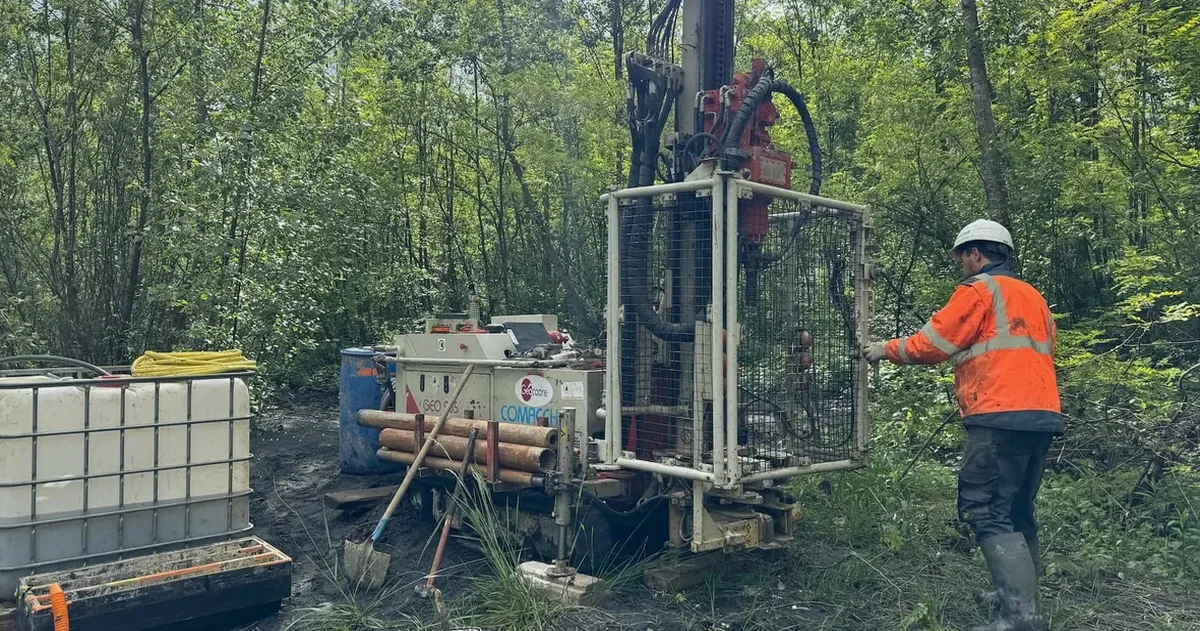
We see it too often in the metro area: a contractor buys a lot in Corktown or Midtown, assumes competent ground, and then the excavator hits saturated silty clay at 12 feet. The budget for deep foundations wasn't in the pro forma. A soil mechanics study in Detroit isn't just a permit checkbox — it's the line between a predictable foundation bid and a change order that eats your entire contingency. Our team has run hundreds of lab programs on glacial lake plain deposits across Wayne County, and we know which parameters control the design when you're dealing with the post-glacial clays that underlie most of the city. The IBC Chapter 18 requirements are clear, but applying them to Detroit's specific stratigraphy takes field judgment that comes from working these soils project after project. We often pair the lab program with in-situ permeability tests when basement dewatering is part of the construction sequence.
Settlement controls Detroit foundations more than bearing capacity. If you don't have a measured Cc and cv from your soil mechanics program, you're guessing on the biggest cost driver in the substructure.
Local ground factors
The Michigan Building Code references IBC 2021 and ASCE 7-22 for geotechnical investigation scope. In Detroit's lake plain soils, the specific risk that catches under-designed projects is time-dependent settlement in normally consolidated clay. We've reviewed forensic files where a structure performed fine for two years, then began differential movement as pore pressures equilibrated under the new fill load. A soil mechanics study that only reports ultimate bearing capacity misses the mechanism that actually governs performance here. The second risk is encountering undocumented fill. Much of Detroit's urban core — especially areas redeveloped after the mid-20th century — has 3 to 15 feet of heterogeneous fill containing brick, ash, slag, and organic debris. Standard penetration testing alone can be misleading in these materials; a lab program that includes moisture-density relationships and collapse potential evaluation gives the structural engineer real numbers to work with instead of conservative assumptions that inflate the foundation cost.
Regulatory framework
ASTM D1586-18 (Standard Test Method for Standard Penetration Test and Split-Barrel Sampling of Soils), ASTM D2487-17e1 (Standard Practice for Classification of Soils for Engineering Purposes — Unified Soil Classification System), ASTM D2435/D2435M-11(2020) (Standard Test Methods for One-Dimensional Consolidation Properties of Soils Using Incremental Loading), ASTM D3080/D3080M-23 (Standard Test Method for Direct Shear Test of Soils Under Consolidated Drained Conditions), IBC 2021 Chapter 18 (Soils and Foundations) and Michigan Building Code, ASCE 7-22 Chapter 20 (Site Classification Procedure for Seismic Design)
Quick answers
What's the typical depth of boring for a soil mechanics study in Detroit?
For most commercial and mid-rise residential projects in the city, we extend borings to 40 to 60 feet below grade, which captures the full lake plain sequence and reaches the underlying glacial till where it exists within that depth. Taller structures or deep excavations may require borings to 80 or 100 feet. The IBC requires borings to extend through all unsuitable strata and into competent bearing material by a depth sufficient to verify continuity.
How long does the lab testing program take from sampling to final report?
A standard program — classification, Atterbergs, direct shear, and one-dimensional consolidation — typically takes three to four weeks from the date samples arrive at our lab. Consolidation tests are the pacing item because each increment requires pore pressure dissipation. Expedited programs can be arranged, but we recommend building a realistic schedule that respects the physics of the tests.
Do you handle the drilling and sampling, or just the lab portion?
We manage the entire field-to-report sequence. Our drill crews use CME-75 and CME-85 rigs with hollow-stem augers and Shelby tube samplers to recover undisturbed samples in the clay layers. The same team that logs the borings also runs the lab tests, which eliminates the disconnect that can happen when drilling and lab work are subcontracted separately.
What seismic site class do Detroit soils typically fall into?
Most of Detroit's lake plain deposits classify as Site Class D (stiff soil) per ASCE 7-22, with shear wave velocities in the 600 to 1,200 ft/s range in the upper 100 feet. However, areas with deeper soft clay profiles — particularly in the lower reaches of the Rouge River basin and near the Detroit River — can drop into Site Class E. A site-specific shear wave velocity measurement is required to confirm the class for structural design.
What's the approximate cost for a soil mechanics study for a typical Detroit commercial building?