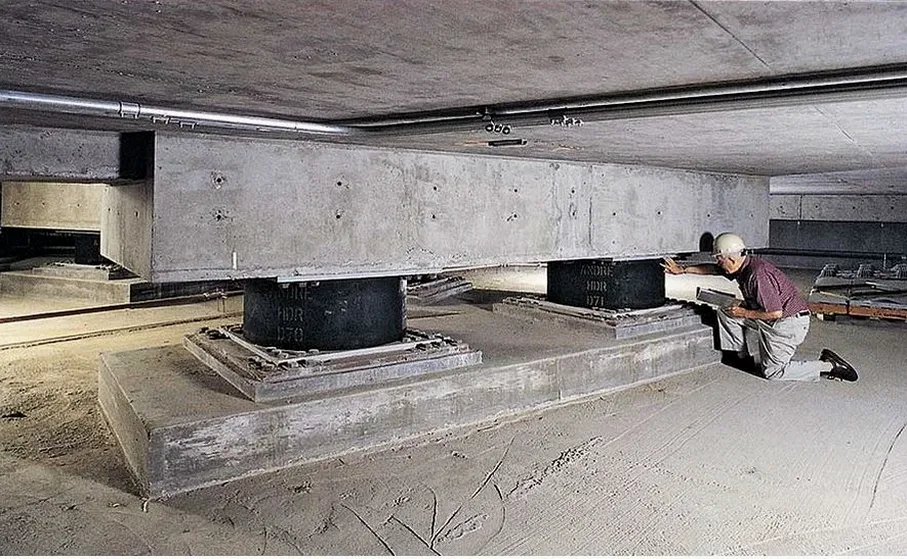
A five-story masonry building from the 1920s in Detroit's Midtown district needed a complete seismic upgrade without altering its historic facade. The challenge wasn't just the structure itself — it was what lay beneath. Detroit sits on a deep sequence of glacial lake plain deposits, alternating between stiff clays and loose silts, with groundwater often within 10 feet of grade. Standard foundation stiffening would have transmitted every tremor straight into the brittle brick. Instead, we designed a base isolation system with laminated elastomeric bearings positioned between the existing foundation and a new structural diaphragm. The isolators decouple the superstructure from ground motion, allowing the building to move as a rigid block while the ground shakes beneath it. For sites with marginal near-surface soils, we often combine this approach with stone columns to improve bearing capacity under the isolation plane. On taller new builds downtown, mat foundations provide a stiff base slab that simplifies isolator layout and reduces differential displacement.
Base isolation in Detroit isn't about designing for the Big One — it's about controlling amplification on soft ground and keeping essential infrastructure running after a moderate regional earthquake.
Local ground factors
Detroit's seismic hazard is moderate by West Coast standards, but the site amplification here can be dramatic. The city anchors the Detroit-Windsor metropolitan region of over 4.3 million people, sitting on up to 120 feet of soft lacustrine sediment over Devonian bedrock. ASCE 7-22 classifies much of the urban core as Site Class E or F — soils that amplify long-period ground motion by a factor of two to three compared to rock. A magnitude 6.0 event in the nearby Southern Great Lakes Seismic Zone, which generated a 4.6 in 2015 near Galesburg, would shake Detroit harder than the epicentral distance suggests. For essential facilities — hospitals, emergency operations centers, the water treatment plants along the Detroit River — base isolation isn't optional engineering; it's the difference between continued operation and months of downtime. The isolators shift the building's fundamental period away from the amplified range, typically from 0.3-0.5 seconds to 2.0-3.0 seconds, cutting lateral forces by 60 to 80 percent. When we evaluate existing foundations, we often run test pits at column locations to verify the concrete condition and confirm geometry before designing the isolation retrofit brackets.
Regulatory framework
ASCE 7-22 Chapter 17 – Seismic Isolation Requirements, ASCE 7-22 Chapter 20 – Site Classification & Soft Soil Amplification, AASHTO Guide Specifications for Seismic Isolation Design (for essential bridges and infrastructure), ASTM D4014 – Standard Specification for Plain and Steel-Laminated Elastomeric Bearings, NCEER/NSF (Youd & Idriss, 2001) – Liquefaction triggering for interbedded silt lenses beneath isolation plane
Quick answers
What does base isolation design cost for a typical mid-rise project in Detroit?
Why is base isolation recommended on Detroit's soft soils when the seismic hazard is moderate?
The hazard is moderate at the bedrock level, but Detroit's deep glacial lake plain deposits amplify motion significantly. Site Class E and F soils can double or triple the spectral acceleration at periods that match typical fixed-base buildings (0.3–1.0 seconds). Base isolation shifts the structure's period to 2.0–3.0 seconds, where the amplified demand drops off sharply. The result is a 60–80% reduction in lateral forces compared to a fixed-base design on the same site.
Can existing buildings in Detroit be retrofitted with base isolation?
Yes, and we have completed several such retrofits in the city. The process involves installing a temporary support system — usually hydraulic jacks on needle beams — cutting the building free from its existing foundation, and inserting isolators between the foundation and a new structural diaphragm. On historic masonry buildings, this requires careful phasing to avoid cracking. The moat around the building must accommodate the design displacement, which on Detroit's soft soils can reach 18–24 inches at the MCE level.
How do you verify that the isolators will perform over the life of the building?
Every isolator type we specify undergoes full-scale prototype testing per ASCE 7-22 §17.8.2: three cycles of loading at the design displacement, plus additional cycles at the maximum considered earthquake displacement. We apply property modification factors for aging, temperature exposure (covering Michigan's -20°F to 120°F range), and scragging — the temporary stiffness increase that occurs in elastomeric bearings after periods of no movement. Factory witness testing and lot acceptance testing on production bearings provide the final verification.
What is the design life of a base isolation system in Detroit's climate?
High-damping rubber and lead-rubber bearings have a design service life exceeding 50 years when properly protected from moisture and ozone. In Detroit's climate, the main durability concern is the freeze-thaw cycling in the isolator pit. We specify neoprene covers for exposed bearing surfaces, design the moat drainage to prevent standing water, and include inspection galleries that allow periodic visual assessment. The isolators themselves are tested under accelerated aging protocols that simulate decades of environmental exposure.