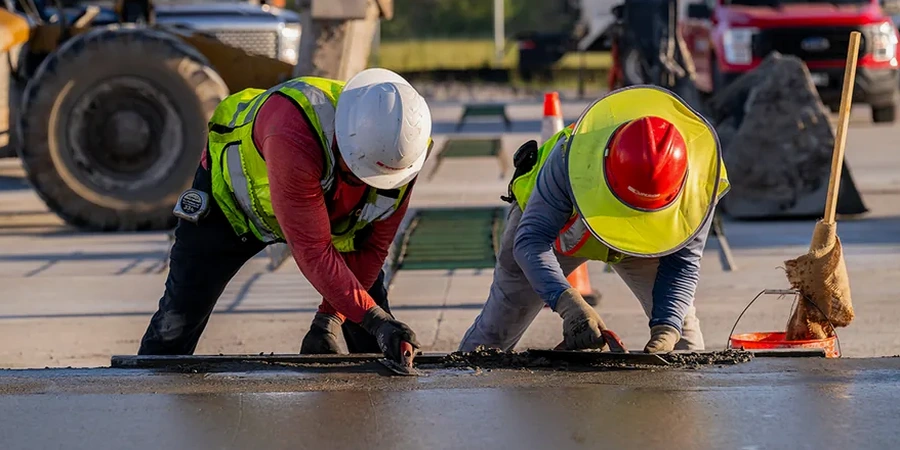
Detroit averages 43 inches of snow a year and sees over 40 freeze-thaw cycles each winter. That statistic alone shapes every rigid pavement design we work on in the city. Concrete slabs here don't just carry traffic loads. They have to survive frost heave in the subgrade, thermal expansion stresses, and the corrosive effects of road salt runoff. In our lab, we start rigid pavement design by characterizing the subgrade. If the silty clays common across southeast Michigan aren't properly addressed in the design, curling stresses at slab edges can double what the structural model predicts. Combining subgrade CBR values with a proper grain size analysis of the base course material gives us the input parameters needed for a PCA or AASHTO design procedure that accounts for Detroit's climate reality. We don't guess at these numbers. We measure them.
In Detroit's climate, a rigid pavement without proper subgrade characterization will show joint deterioration within the first three winter cycles.
Local ground factors
The IBC Chapter 18 and AASHTO pavement design guide both emphasize subgrade uniformity as a prerequisite for rigid pavement performance, and in Detroit that requirement carries extra weight. The city's post-industrial landscape contains pockets of compressible fill, abandoned basements, and old sewer trenches that create differential support conditions under a concrete slab. When a rigid pavement spans across a stiff clay zone into a softer backfill area, the slab acts as a bridge. If the bending stress exceeds the concrete's modulus of rupture, you get transverse cracking. Our lab runs a minimum of three subgrade reaction modulus tests per 5,000 square feet of pavement area in Detroit, and we increase that density where historical records or site observations suggest fill irregularities. Pumping at joints is another Detroit-specific concern. Saturated fine-grained subgrade under repeated wheel loads forces water and soil fines up through the joints, eroding support and leading to faulting.
Quick answers
How much does rigid pavement design cost for a Detroit project?
What makes rigid pavement different from flexible pavement?
Rigid pavement distributes loads through the flexural strength of the concrete slab rather than through a thick layered base. In Detroit's freeze-thaw climate, rigid pavements resist rutting from snowplow chains better than asphalt, but they require careful joint design to handle thermal expansion.
How do you determine the slab thickness for a Detroit industrial yard?
Slab thickness is calculated using the AASHTO design equation, which factors in the concrete's flexural strength, the subgrade k-value, and the expected ESAL loading. For Detroit industrial yards with container handling equipment, we typically see thicknesses between 8 and 11 inches.
Do you test the subgrade before starting the pavement design?
Yes, subgrade testing is the first step. We run plate load tests to get the modulus of subgrade reaction directly, and we also take samples for laboratory CBR and classification testing. Without this data, any rigid pavement design for Detroit's variable soil conditions is just speculation.