← Home · Slopes & Walls

Active and Passive Anchor Design for Detroit Soils

Together, we solve the challenges of tomorrow.

LEARN MORE →

Detroit’s subsurface tells a story of glacial lake plains, riverine deposits, and nearly two centuries of industrial infill. The city sits on a complex stratigraphy where natural cohesionless soils interlace with anthropogenic fill—brick fragments, cinders, demolition debris—that makes anchor design anything but routine. When a retaining wall goes up along the RiverWalk or a deep excavation opens near the RenCen, the difference between a passive bar anchor and a post-tensioned active tendon is decided by stratigraphy, not just structural loads. Our lab handles the bond zone verification, pullout testing, and grout-to-ground friction analysis that Detroit’s variable conditions demand, including the evaluation of in-situ permeability when groundwater complicates tendon installation near the Detroit River.

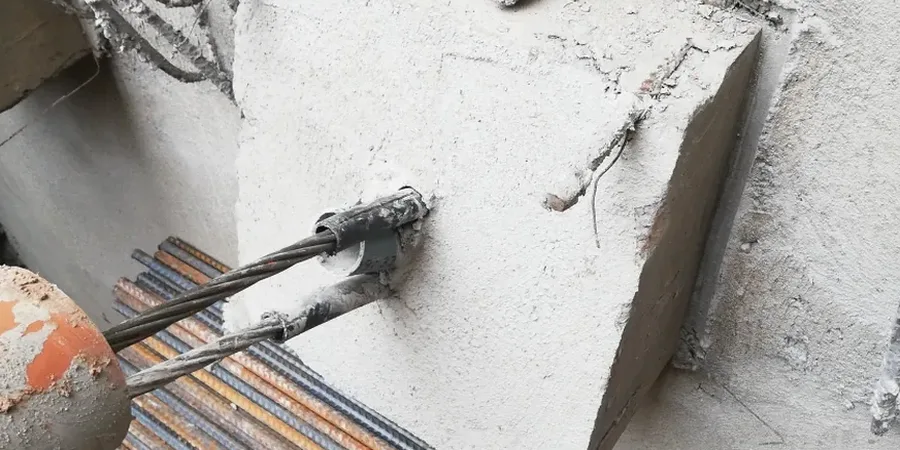
A properly locked-off active anchor in Detroit’s post-industrial fill transfers load to a stratum that may sit just two feet deeper than expected—verification drilling is not optional.
Process and scope

The city’s average elevation of roughly 600 feet above sea level masks a subsurface where soft organic silts and lacustrine clay layers often appear within the top 30 feet. In active anchor design, load is transferred beyond the failure plane into a competent bond zone—but defining “competent” in Detroit requires careful logging because fill thickness can vary from 3 to over 25 feet across a single block. We run laboratory shear strength tests on Shelby tube samples from anchor bond zones, and we cross-reference results with site-specific CPT data to validate grout-to-ground friction assumptions before any stressing sequence begins.
Active and Passive Anchor Design for Detroit Soils
Technical reference image — Detroit

Local ground factors

We reviewed a basement excavation on Woodward Avenue where a soldier pile and anchor system was designed assuming a homogeneous clay layer. The boring logs told a different story: a 14-foot pocket of saturated sandy fill at the anchor bond zone, completely missed by the preliminary investigation. The project team had to redesign the anchor free length and switch from a passive to an active system with a lock-off load that prevented wall movement in the upper fill. Without supplemental sampling at the anchor elevation, the wall would have crept forward enough to crack the adjacent sidewalk. Detroit’s buried industrial history—old foundations, backfilled basements, undocumented utility trenches—creates exactly this kind of surprise, and anchor capacity predictions that rely solely on generalized soil parameters will fail when the drill hits a buried brick arch at 25 feet.

Need a geotechnical assessment?

Reply within 24h.

Email: contact@geotechnicalengineering.biz

Reference parameters

ParameterTypical value
Anchor typeActive (post-tensioned) or passive (grouted bar)
Bond zone verificationShelby tube sampling and laboratory shear testing
Grout strength validationUnconfined compression at 7 and 28 days (ASTM C109)
Tendon materialASTM A416 strand or ASTM A615 threaded bar, depending on corrosion environment
Pullout test protocolIncremental loading per PTI DC35.1 recommendations
Soil-grout interface frictionBack-calculated from field test data and lab direct shear
Groundwater considerationPiezometer monitoring during drilling and grouting stages

Other technical services

01

Anchor Bond Zone Investigation

Soil sampling and laboratory shear strength testing at the proposed bond zone elevation, providing site-specific friction values for active and passive anchor design calculations.

02

Field Pullout Testing

Incremental load testing on sacrificial anchors to validate design assumptions before production installation, with load-displacement curves correlated to subsurface conditions.

03

Grout and Tendon Quality Verification

Compressive strength testing of neat cement grout at 7 and 28 days, plus tendon material certification review against ASTM standards for corrosion-sensitive environments.

Regulatory framework

IBC Chapter 18 (Soils and Foundations) — anchor load transfer and corrosion protection requirements, PTI DC35.1 — Recommendations for Prestressed Rock and Soil Anchors, ASTM A416 — Low-Relaxation Seven-Wire Steel Strand for Prestressed Concrete

Quick answers

When is an active anchor system required instead of a passive one in Detroit?

Active anchors become necessary when allowable wall movement is very small—for example, adjacent to historic masonry buildings in Corktown or infrastructure near the People Mover guideway. The post-tensioning locks in a compressive force against the soil before any excavation-induced movement occurs. Passive anchors develop resistance only as the wall displaces, which works for less sensitive sites but can cause unacceptable settlement in Detroit’s soft fill zones.

How do you determine the bond zone length in Detroit’s variable fill conditions?

We do not rely on textbook friction values. Shelby tube samples are taken from the proposed bond zone depth and tested in direct shear to measure the soil-grout interface friction angle. Combined with CPT tip resistance data, we back-calculate a unit bond stress that reflects actual site conditions rather than regional averages that may miss pockets of industrial debris.

What is the typical cost range for anchor design verification services in Detroit?
How does groundwater near the Detroit River affect anchor grouting?

High groundwater can dilute neat cement grout during placement, reducing final compressive strength and bond capacity. We specify grout placement through tremie pipes in submerged zones and test grout samples cured under water to confirm that the design strength is achieved. Piezometer readings before and during grouting help confirm that the grout column remains intact.

Location and service area

We serve projects across Detroit and surrounding areas.

View larger map