Together, we solve the challenges of tomorrow.
LEARN MORE →In Detroit's evolving landscape, the integrity of slope stability and structural walls is not merely a design consideration but a fundamental safety imperative. The category of Slopes & Walls encompasses the engineering disciplines required to stabilize natural terrain, support deep excavations, and construct durable retaining structures. Given the city's unique post-industrial topography and aging infrastructure, these services are critical for preventing landslides, protecting property, and ensuring the longevity of new developments. From the riverfront districts to the inland neighborhoods, managing earth pressures and groundwater is a constant challenge that defines the feasibility of any project involving a change in grade.
The geological context of Detroit is dominated by glacial history, which deposited a complex stratigraphy of clay-rich tills, lacustrine silts, and sandy outwash over bedrock. This legacy creates highly variable ground conditions, with the stiff, overconsolidated clays being particularly prone to softening and strength loss upon exposure. Seasonal precipitation and freeze-thaw cycles exacerbate these issues, leading to surface erosion and shallow sloughing on unprotected slopes. Furthermore, the presence of buried urban fill, often containing debris from demolition and industrial byproducts, introduces zones of unpredictable compressibility and permeability. A thorough understanding of these local soil behaviors is essential for any retaining wall design or slope intervention to avoid costly failures.
All geotechnical work in this domain must strictly adhere to the governing standards set forth in the Michigan Building Code, which largely adopts the International Building Code (IBC) with state-specific amendments. Chapter 18 of the IBC, addressing Soils and Foundations, mandates rigorous site characterization, bearing capacity calculations, and lateral earth pressure analyses. For slope stability, engineers follow recognized methodologies, often referencing guidelines from the U.S. Army Corps of Engineers or FHWA, to achieve minimum factors of safety. The design of structural walls must comply with ACI 318 for concrete and AISC 360 for steel, while earth retention systems must account for both active and passive pressures as defined by local geotechnical parameters. Permitting through the City of Detroit's Buildings, Safety Engineering and Environmental Department requires sealed calculations that demonstrate full compliance with these codes.
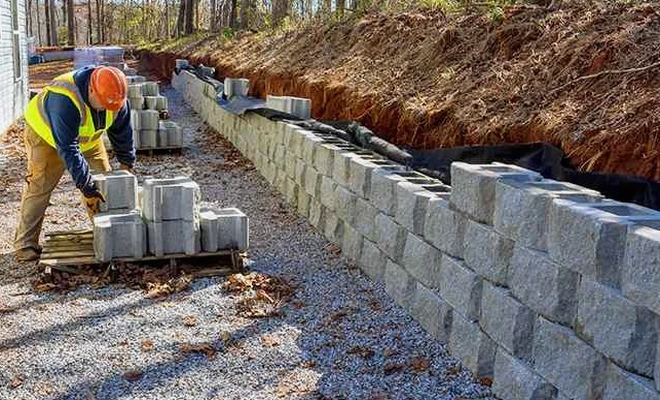
The practical application of slope and wall engineering spans a wide array of project types across Metro Detroit. Infrastructure upgrades, such as the widening of freeway embankments and the construction of new stormwater detention basins, rely heavily on stable reinforced slopes. Urban infill projects on constrained sites demand advanced active/passive anchor design to support deep basement excavations without encroaching on adjacent rights-of-way. The rehabilitation of the city's iconic riverfront and the transformation of vacant lots into commercial developments frequently require tiered retaining walls to create usable, flat building pads. Even residential construction on the region's many lakeside bluffs necessitates engineered solutions to combat ongoing erosion and protect property values.
Instability is most often triggered by a combination of the region's glacial clay soils, which lose strength when saturated, and poor drainage management. Intense rainfall and snowmelt infiltrate the ground, increasing pore water pressure and reducing effective stress. Additionally, human activities like improper grading, removal of vegetation, and uncontrolled surface water flow onto a slope can accelerate erosion and lead to progressive failure.
A retaining wall becomes necessary when space constraints prevent a sloped embankment, or when a near-vertical face is needed to maximize usable land on a tight urban lot. Walls are also specified for deep basement excavations where lateral support is critical, for stabilizing steep cuts below roadways, or for providing robust structural support against high lateral earth pressures that a vegetated slope cannot safely resist.
The design is governed by the Michigan Building Code, which incorporates the International Building Code (IBC) with local amendments. Specifically, IBC Chapter 18 outlines requirements for geotechnical investigations, allowable bearing pressures, and lateral soil loads. Retaining walls must also meet the structural provisions of ACI 318 for concrete or AISC 360 for steel, with all plans requiring a professional engineer's seal for city permitting.
The process begins with a subsurface exploration program involving soil borings and test pits to log the stratigraphy and collect samples. Laboratory testing then determines key engineering properties like shear strength, compressibility, and moisture content. This data is used to build a geotechnical model for analyzing global stability, calculating lateral earth pressures, and modeling groundwater flow, which directly informs the selection and design of the appropriate support system.