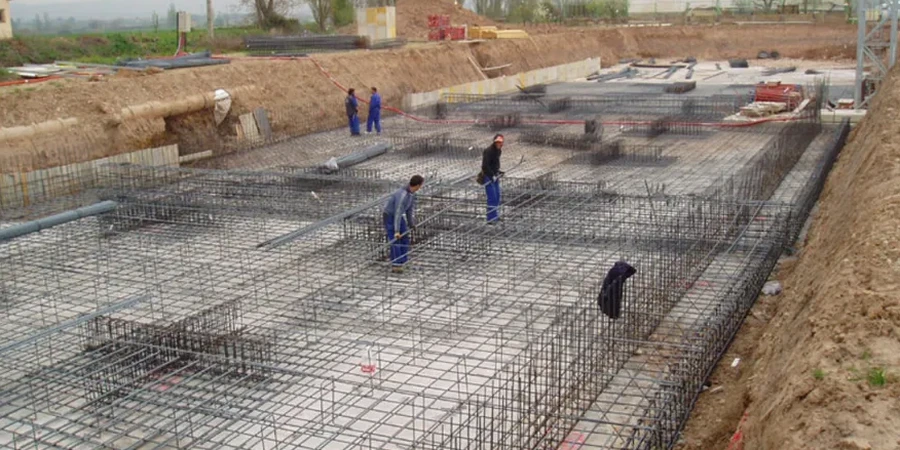
Detroit’s foundation engineering must contend with a complex glacial geology—predominantly stiff to very stiff clay till interbedded with silty sand lenses, often in close proximity to fluctuating groundwater. Compliance with the 2015 Michigan Building Code (adopting IBC 2015 with state amendments) governs bearing capacity, settlement, and frost depth, while deep foundations must address the region’s variable drift thickness over bedrock. Our category covers the full lifecycle from geotechnical investigation to design, including advanced pile foundation design for sites where shallow bearing is insufficient.
These solutions are essential for downtown high-rises on compressible urban fill, heavy industrial plants along the Detroit River, and infrastructure projects requiring high lateral resistance in soft clays. We also integrate deep foundation testing to verify capacity and integrity per ASTM standards, ensuring long-term performance. Every design is tailored to Detroit’s unique subsurface conditions, delivering safe and economical foundations for even the most demanding structures.
Soil sampling and laboratory shear strength testing at the proposed bond zone elevation, providing site-specific friction values for active and passive anchor design calculations.
Incremental load testing on sacrificial anchors to validate design assumptions before production installation, with load-displacement curves correlated to subsurface conditions.
Compressive strength testing of neat cement grout at 7 and 28 days, plus tendon material certification review against ASTM standards for corrosion-sensitive environments.
IBC Chapter 18 (Soils and Foundations) — anchor load transfer and corrosion protection requirements, PTI DC35.1 — Recommendations for Prestressed Rock and Soil Anchors, ASTM A416 — Low-Relaxation Seven-Wire Steel Strand for Prestressed Concrete
Active anchors become necessary when allowable wall movement is very small—for example, adjacent to historic masonry buildings in Corktown or infrastructure near the People Mover guideway. The post-tensioning locks in a compressive force against the soil before any excavation-induced movement occurs. Passive anchors develop resistance only as the wall displaces, which works for less sensitive sites but can cause unacceptable settlement in Detroit’s soft fill zones.
We do not rely on textbook friction values. Shelby tube samples are taken from the proposed bond zone depth and tested in direct shear to measure the soil-grout interface friction angle. Combined with CPT tip resistance data, we back-calculate a unit bond stress that reflects actual site conditions rather than regional averages that may miss pockets of industrial debris.
High groundwater can dilute neat cement grout during placement, reducing final compressive strength and bond capacity. We specify grout placement through tremie pipes in submerged zones and test grout samples cured under water to confirm that the design strength is achieved. Piezometer readings before and during grouting help confirm that the grout column remains intact.
This service complements our laboratory testing work for a complete project analysis.