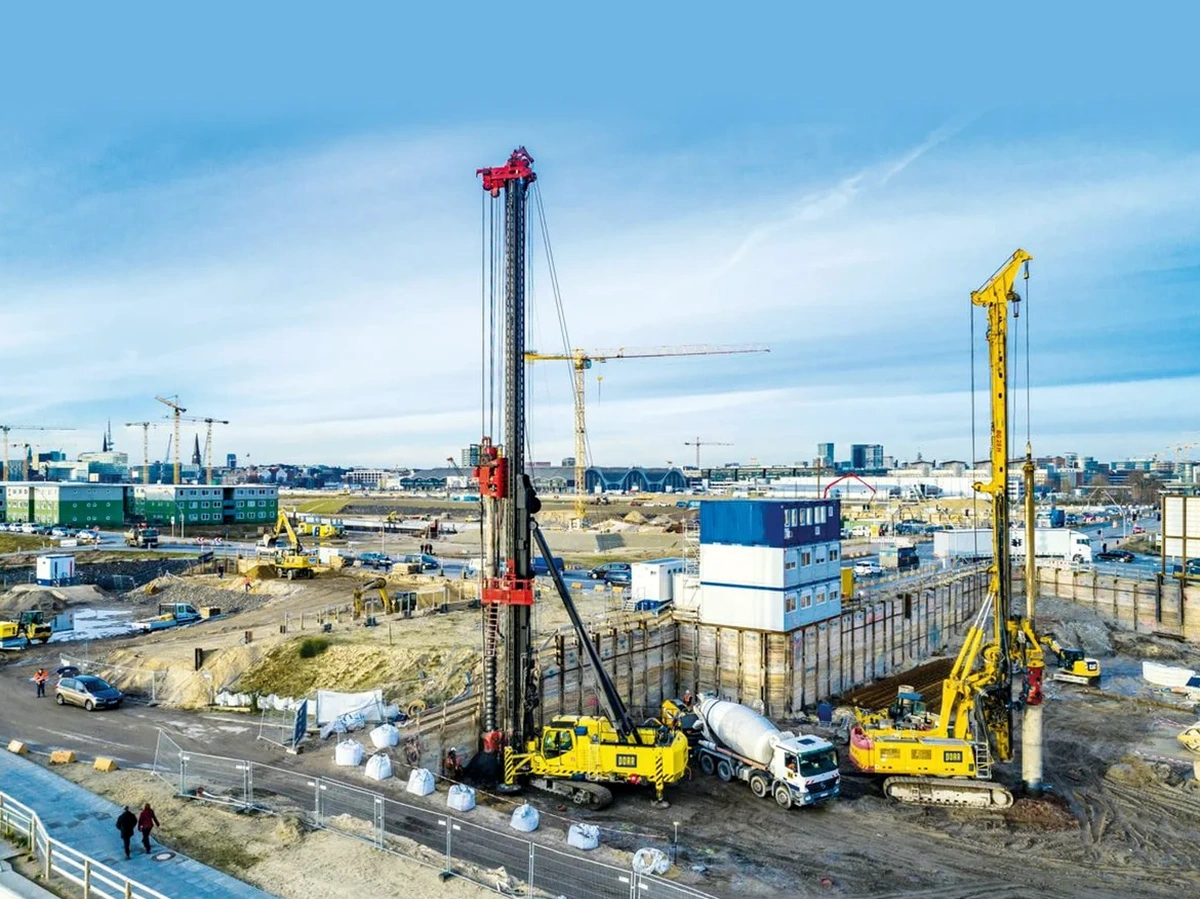
A six-story mixed-use building near Eastern Market ran into a problem we see all the time in Detroit. The top six feet of soil looked fine during the initial walkthrough, but the borings told a different story. Soft gray clay extended down thirty feet before hitting competent bearing strata. That’s the legacy of the old Lake Maumee lakebed, and it means shallow footings were completely off the table. The structural engineer called us on a Thursday, and by Monday we had a preliminary pile design on his desk. In this city, where glacial lake plains meet a century of urban fill and demolition debris, designing foundations is less about textbook formulas and more about reading what the ground actually gives you. We complement that with grain-size analysis when the clay layers show silty interbeds that can mess with skin friction calculations.
In Detroit’s lakebed clays, pile design isn’t about finding rock — it’s about finding the depth where settlement becomes predictable.
Local ground factors
Detroit sits at roughly 600 feet above sea level on a glacially flattened plain, and that flat topography hides a real risk: differential settlement across a single building footprint. When you’re dealing with urban fill — brick, cinders, old foundation remnants — the compressibility can change within ten linear feet. We saw it on a warehouse rehab near the riverfront where one corner of the slab settled two inches more than the opposite corner inside of eighteen months. The original builder had used shallow footings on uncontrolled fill, and the fix involved underpinning with micropiles after the fact, which cost four times what a proper pile foundation would have cost at the start. Pile design in Detroit also has to account for seasonal groundwater swings. Spring thaw pushes the water table up into the clay, reducing effective stress and temporarily softening the upper bearing layers. We factor that into our axial capacity calculations so the piles perform year-round, not just during the dry August conditions when some firms run their borings.
Regulatory framework
IBC Chapter 18 (Soils and Foundations, 2021 edition), ASTM D1586-18 (Standard Penetration Test), ASCE 7-22 (Minimum Design Loads), AASHTO LRFD Bridge Design Specifications, 10th Edition, Section 10, ACI 543R-12 (Guide for Design of Concrete Piles)
Quick answers
How much does a pile foundation design cost for a Detroit project?
For a typical commercial or multifamily project in Detroit, the geotechnical investigation and pile design package ranges from US$1,660 to US$6,090 depending on the number of borings, depth of exploration, and complexity of the structural loads. A small site with two borings and a straightforward pile recommendation falls at the lower end. A larger footprint requiring deep borings, lab testing, and lateral analysis moves toward the upper end. We provide a fixed-scope proposal after reviewing the site address and structural plans.
What pile types work best in Detroit’s soil conditions?
It depends entirely on the depth to bearing material and the groundwater table at the specific site. Downtown, we often specify driven H-piles or closed-end pipe piles when the competent till is within 50 feet. For sites with deeper clay, augered cast-in-place piles or drilled shafts can reach 70 to 100 feet without the vibration concerns that come with driving near historic masonry buildings. We make the final recommendation after seeing the boring logs and lab results.
Do I need a pile foundation for a single-family home in Detroit?
Most residential construction in the Detroit metro area uses shallow footings, but there are exceptions. If your lot is on documented urban fill, near a former industrial site, or in a low-lying area with soft organic soils near the top, we may recommend helical piles or small-diameter drilled piers to avoid future settlement problems. We evaluate each residential site individually rather than applying a blanket rule.