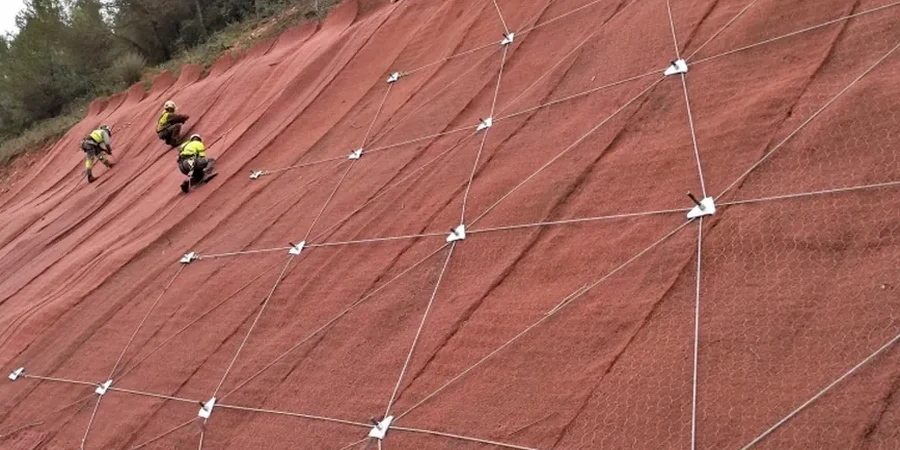
IBC Section 1803.5.3 explicitly requires slope stability assessment where site topography or soil conditions indicate potential instability, and that description fits a surprising number of projects across the Detroit metro. The glacial lake plain that defines most of Wayne County left behind layered deposits of clay, silt, and sand that behave very differently in a cut slope than the compacted clays you see in the western part of the state. Our laboratory runs direct shear and triaxial tests on undisturbed Shelby tube samples pulled from the slope zone, then feeds those parameters into limit-equilibrium models using Spencer or Morgenstern–Price methods. When the project sits near the Detroit River or along one of the tributary ravines in the Grosse Pointes, we also factor in rapid drawdown scenarios and long-term pore pressure evolution, which often control the factor of safety more than the slope angle itself. For deeper failure surfaces where the glacial stratigraphy gets complicated, we complement the analysis with CPT testing to map continuous strength profiles without losing the sample structure, and pair it with in-situ permeability measurements where perched water tables are suspected.
Detroit's lacustrine clays develop perched water tables in spring that reduce the factor of safety more than any other single variable in our slope models.
Process and scope
The field setup starts with a truck-mounted CME-75 drill rig pushing 3-inch Shelby tubes into the slope at two to three vertical locations: one near the crest, one mid-slope, and one at the toe. Each tube gets waxed, capped, and transported back to our Michigan Avenue lab in insulated boxes so the moisture content stays intact. In the geotech lab we run a suite that includes consolidated-undrained triaxial with pore pressure measurement, Atterberg limits on the clay seams, and direct shear on the sandier interbeds. The triaxial cell gets saturated under back-pressure, then sheared at strain rates slow enough to allow pore pressure equalization, which matters enormously for the Detroit clays and their overconsolidated behavior. Once we have the effective stress parameters, the analysis moves into SLIDE2 or PLAXIS 2D to model the actual slope geometry. We look at both circular and block-type failure mechanisms because the stratified lacustrine soils here can produce translational slides along silt layers that a simple circular search misses completely. The output is a factor of safety for static and pseudostatic conditions, plus a sensitivity analysis that shows how much the water table has to rise before things get marginal.
Local ground factors
The freeze-thaw cycling that Detroit gets from November through March creates a failure mechanism that slope stability textbooks don't always emphasize. Water infiltrates desiccation cracks in the clay crust during fall rains, freezes in January, then thaws in late March when the ground is still saturated underneath. The upper two to three feet lose cohesion almost overnight, and we've seen slope failures in places like the River Rouge industrial corridor that initiated from this exact process, not from the classic deep-seated rotational slide. Our analysis for projects with winter exposure explicitly models this near-surface strength reduction zone, applying a reduced cohesion envelope in the upper weathered layer. The other factor that surprises out-of-state engineers is how much the Detroit River and its connecting waterways influence groundwater levels up to half a mile inland, creating fluctuating phreatic surfaces that rise and fall with lake levels. A slope that calculates at FS=1.8 in August can drop to FS=1.1 in April if the model doesn't account for the seasonal high groundwater, and that's the kind of detail we've learned to check after running these analyses for projects from downtown to the Downriver communities.
Quick answers
What's the typical cost for a slope stability analysis on a Detroit site?
For a single slope cross-section with field investigation and lab testing, our analyses typically range from US$1,180 to US$3,890 depending on the number of boreholes, the lab testing suite required, and whether pseudostatic seismic analysis is included. A small residential cut slope with two boreholes and basic direct shear testing stays at the lower end, while a commercial development needing triaxial testing, multiple cross-sections, and rapid drawdown modeling runs toward the upper end.
How do you determine which shear strength parameters to use for Detroit clays?
We run consolidated-undrained triaxial tests with pore pressure measurement on undisturbed Shelby tube samples, which gives us both total and effective stress parameters. For the overconsolidated glacial clays common in Wayne County, the effective stress envelope with c' and phi' is almost always more appropriate than total stress analysis, especially for long-term slope conditions where pore pressures have equilibrated. We also check the stress history from consolidation tests to confirm whether the clay is normally consolidated or overconsolidated at the depth of the failure surface.
How long does a complete slope stability investigation take from start to finish?
Field drilling and sampling for a typical slope takes one to two days on site. Lab testing runs about two weeks for the full suite including triaxial, direct shear, and consolidation. Once we have the parameters, the modeling and report preparation takes another week. So for a standard project you're looking at three to four weeks from mobilization to final report, though we can expedite critical parameters if a contractor is waiting on a cut slope decision.
Do you include seismic slope stability analysis for Detroit projects?
Yes, we include pseudostatic analysis using the horizontal seismic coefficient from ASCE 7-22 based on the site class and mapped spectral accelerations for Wayne County. Detroit sits in a region of moderate seismicity, and while the design ground motions are lower than what you'd see on the West Coast, the soft lake plain soils can amplify motions at certain periods. Our models apply the kh coefficient to the driving force and check whether the factor of safety drops below 1.1 under seismic conditions, which is the commonly accepted minimum for temporary pseudostatic loading.