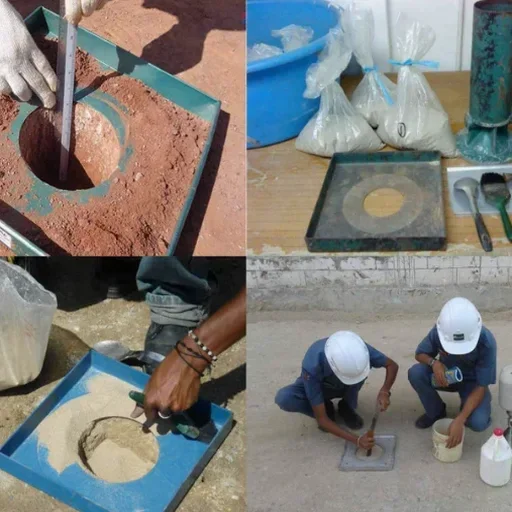
The sand cone apparatus shows up on a Detroit site in a yellow Pelican case, usually caked in dust from the last eight lots. It contains a double-cone valve, a one-gallon threaded jar, and a precisely graded Ottawa sand that is calibrated fresh every morning before the humidity in the air shifts. We set the base plate on the compacted lift, level it against the grade stakes, and start digging. The hole is typically 4 to 6 inches deep in a subbase of MDOT 21AA crushed limestone, or sometimes deeper when the spec requires verification through the full lift thickness. In this city, where post-industrial fill and glacial lakebed clays sit side by side, the Proctor curve is the first thing we reference before a single ounce of sand leaves the jar. The test itself is straightforward: excavate, weigh the removed soil, fill the void with calibrated sand, calculate the in-place wet density, and correct for moisture in the field lab. A single test takes about 20 minutes when the surface is prepped and the nuclear gauge is not allowed because of adjacent utilities or local ordinance.
Detroit's glacial lakebed clays shift density by 4 pcf with a 2 percent moisture change. The sand cone catches what a nuclear gauge misses in those conditions.
Local ground factors
Detroit sits on a bench of glacial Lake Maumee, which left behind a layer cake of stiff clay, silt, and pockets of compressible organic material within 15 feet of the surface. That geology means the fill you are compacting in August at 14 percent moisture can drop to 9 percent after three dry weeks and shrink away from a foundation wall. The sand cone test captures the density at the moment of placement, but the long-term performance depends on whether the moisture content was within 2 percent of optimum when the lift was sealed. We have pulled cores through asphalt patches in Southwest Detroit where the base course was compacted dry and lost 30 percent of its design CBR within two years. On riverfront sites with undocumented fill, the sand cone serves as a forensic tool: we test around gas main trenches and old basement backfills to verify that the compaction log matches reality. When it does not, the fix usually involves undercutting and recompacting in thin lifts with a vibrocompaction pass on granular material or lime treatment on fat clays.
Quick answers
What is the typical cost for a sand cone density test in Detroit?
A single sand cone density test, including field moisture determination and a signed PDF report, generally ranges from US$100 to US$130 per test with a minimum mobilization. The unit rate drops for projects with ten or more tests per day because the technician can calibrate once and test continuously. Factors that affect cost include the distance from our Detroit field office, the need for off-hours testing around active construction traffic, and whether the Proctor curve already exists or must be developed in the lab.
How does the sand cone method compare to a nuclear density gauge on Detroit clay soils?
The sand cone is a direct measurement: you excavate the soil, weigh it, and measure the hole volume with calibrated sand. A nuclear gauge infers density from gamma radiation backscatter or direct transmission, which can be biased by the chemical composition of Detroit's glacial clays — specifically high iron content and variable organic matter. On MDOT projects, the sand cone is the referee method when nuclear gauge readings are in dispute. The trade-off is speed: a nuclear gauge gives a reading in two minutes, while a sand cone takes 20 to 25 minutes.
Can you run sand cone tests on crushed concrete or slag fill?
Yes, with adjustments. Crushed concrete and slag fill are common on Detroit brownfield sites. The test hole must be larger — typically 8 to 10 inches in diameter — to accommodate the 3-inch minus particle size, and the calibration sand must be rechecked because the larger void volume increases the relative error if the sand bulk density shifts during the test. We also oven-dry the excavated material because slag retains moisture differently than natural aggregate, and the Speedy moisture tester can give false readings on slag due to the calcium oxide reaction.
What qualifications should a field density technician hold in Michigan?
The technician should hold current MDOT Density Technology certification or an equivalent credential such as NICET Level II in Geotechnical Engineering Technology – Construction. Our Detroit field team operates under an AASHTO-accredited laboratory quality system, and every sand cone report is reviewed by a licensed professional engineer before it leaves the trailer. The calibration sand is verified with a density cone and one-gallon container traceable to an ASTM C778 reference sand every morning before testing begins.