← Home · Ground improvement

Vibrocompaction Design in Detroit: Densifying Fill and Loose Sands

Together, we solve the challenges of tomorrow.

LEARN MORE →

Detroit's soil profile rarely starts with clean, competent ground. We encounter old riverbed deposits, demolition debris, and industrial fill that was never engineered for structural loads. Standard over-excavation hits groundwater fast or becomes a disposal nightmare on tight urban lots near the Dequindre Cut or Corktown. Vibrocompaction changes the equation. We densify loose granular soils in place, using depth vibrators to rearrange particles into a tighter matrix. This is not a one-size-fits-all method. It demands a design calibrated to the grain-size distribution from lab tests like grain size and the fines content from atterberg limits. In Detroit, where the Pleistocene lakebed sands can be loose to 30 feet, a properly designed vibro program turns problematic ground into a competent bearing stratum without hauling off a single truckload of spoils.

In Detroit's glacial sands, a well-designed vibro grid can double SPT blow counts in a single pass, eliminating over-excavation entirely.

Methodology and scope

We recently completed a vibro design for a six-story mixed-use building on Gratiot Avenue. The site had 12 feet of silty sand over glacial till. The original spec called for over-excavation and engineered fill, but the water table sat at 6 feet. Dewatering costs alone would have killed the budget. We designed a triangular grid at 7.5-foot spacing, targeting a relative density above 70% for the full treatment depth. Power consumption on the rig was our real-time QC metric. Each probe logged amperage and penetration speed. We cross-checked with post-treatment SPT blows from SPT drilling. The average N-value jumped from 8 to 22. That is the difference between a mat foundation and simple spread footings. The owner saved three weeks on the schedule and reduced the concrete volume by 40%. Detroit's glacial geology often delivers sands that respond extremely well to vibration, but the window is narrow. Too much silt and you are wasting energy. That is why the design phase requires precise lab data.
Vibrocompaction Design in Detroit: Densifying Fill and Loose Sands
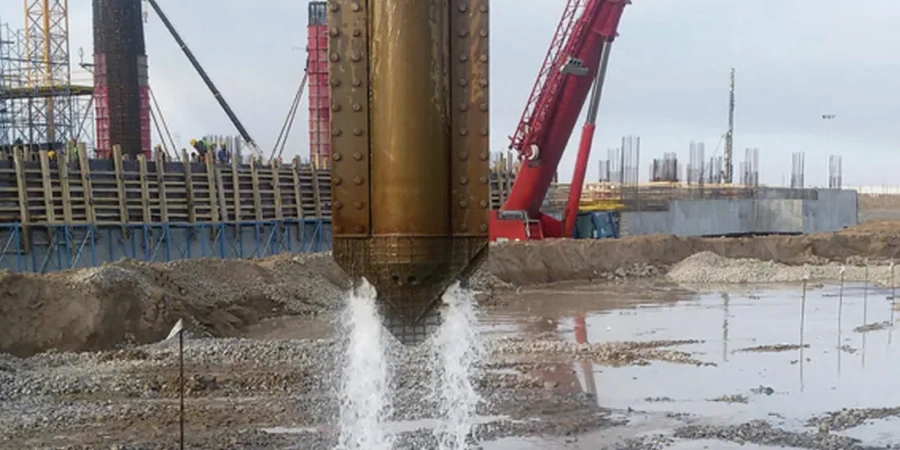
Technical reference image — Detroit

Local considerations

ASCE 7 and the Michigan Building Code require that bearing soils support design loads without excessive settlement. On Detroit's loose fill sites, skipping a vibrocompaction design carries two specific risks. First, differential settlement tears apart slab-on-grade floors and partitions within the first two years. We have inspected buildings in Southwest Detroit where floor slabs had settled 3 inches because the fill was not densified before construction. Second, loose saturated sands below the water table can liquefy during a seismic event. The Detroit River basin sits on deep deposits of sand that the USGS maps as potentially liquefiable. A vibro design that ignores the fines content or the groundwater chemistry will fail. We have seen probes freeze in zones of high carbonate content where the vibration induces calcite precipitation. The soil literally cements itself to the vibrator. A competent design anticipates these local quirks and adjusts the water flush rate or the probe geometry before mobilization.

Need a geotechnical assessment?

Reply within 24h.

Email: contact@geotechnicalengineering.biz

Technical parameters

ParameterTypical value
Typical treatment depth15 to 40 ft below grade
Effective soil typesClean sands (FC < 12%), silty sands (FC < 20%)
Grid patternTriangular, 5 to 10 ft spacing
Target relative density70% to 85% (per IBC Section 1805)
QC methodReal-time amperage logs, pre/post SPT verification
Vibrator power130 to 200 kW electric or hydraulic
Settlement after compaction5% to 12% of treatment thickness

Associated technical services

01

Vibrocompaction Design Package

Full design including grid geometry, probe spacing, treatment depth, power specs, and acceptance criteria based on site-specific grain-size and Atterberg data.

02

Pre-Treatment Soil Characterization

Lab testing program to determine fines content, grain-size distribution, and maximum/minimum density. We confirm that soils fall within the vibro-applicable range before design begins.

03

Field QC and Post-Treatment Verification

On-site supervision of the vibro rig, real-time monitoring of amperage and penetration logs, and post-treatment SPT or CPT verification to confirm design targets are met.

04

Liquefaction Mitigation Design

Vibrocompaction design specifically aimed at increasing relative density to meet liquefaction resistance criteria under the design earthquake, per NCEER and Youd-Idriss procedures.

Applicable standards

ASCE 7-22 Minimum Design Loads and Associated Criteria for Buildings and Other Structures, IBC 2021 Section 1805: Dampproofing and Waterproofing, ASTM D1586-18 Standard Test Method for Standard Penetration Test (SPT), ASTM D4253/D4254 for maximum and minimum index density, FHWA-NHI-16-072 Ground Improvement Methods

Frequently asked questions

How much does vibrocompaction design cost for a typical Detroit lot?

For a standard commercial lot in Detroit, the design package including lab testing and field QC oversight typically ranges from US$1.530 to US$5.060, depending on the number of probes, treatment depth, and verification testing required.

Does vibrocompaction work on old demolition fill in Detroit?

It depends on the debris size and the fines matrix. If the fill is predominantly granular with bricks and concrete fragments under 6 inches, vibration can densify the matrix around the debris. Large obstructions, organic layers, or high clay content will defeat the process. We run a grain-size analysis and a visual classification from test pits before committing to a vibro design.

How do you verify that the ground has been adequately densified?

We use real-time power consumption logs on the vibrator as a primary QC metric. The amperage draw correlates directly with soil resistance. We then verify with post-treatment SPT or CPT soundings on a grid. The acceptance criterion is typically a minimum N-value or tip resistance at each test location, consistent with the design relative density.
Location and service area

We serve projects across Detroit and surrounding areas.

View larger map