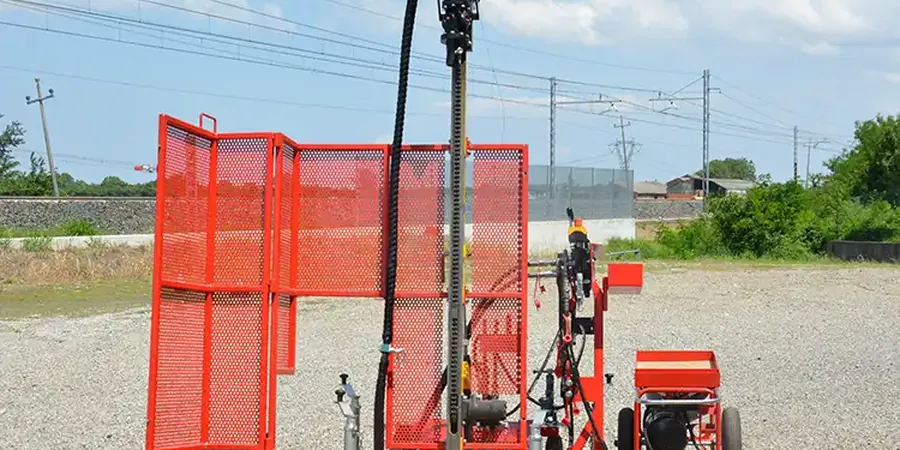
When you drive piles or excavate near the Detroit River, you quickly learn that the soil column here rarely matches the textbook. Glacial lakebed clays, loose silts, and old industrial fill are layered in ways that can shift within a single city block. Our team runs SPT borings across Wayne County, and what stands out is how often the blow counts jump from N=4 to N=22 in less than three vertical feet. The Standard Penetration Test gives us that resolution—a 24-inch reading at a time, correlated to decades of local geotechnical data tied to Detroit's post-glacial stratigraphy. For sites where the upper 10 feet show erratic refusal, we also pair the SPT program with CPT soundings to capture a continuous tip resistance profile through the transition zone.
In Detroit's urban fill zones, SPT refusal at 4 feet often masks a soft organic layer at 12 feet—missing that transition is where foundation problems begin.
Process and scope
ASTM D1586-18 governs every SPT boring we execute in Detroit, from the hammer type calibration to the split-spoon sampler dimensions. We run an automatic trip hammer with energy correction factors documented per blow count, so the N60 values you receive are normalized and ready for liquefaction assessment under ASCE 7-22 or direct input into FHWA-driven pile capacity methods. The city's typical profile—soft clay over glacial till—demands careful sampling intervals. We space tests at 2.5 feet continuously through the upper 30 feet, then switch to 5-foot intervals in competent till. Each sample is logged in the field per ASTM D2488 (Visual-Manual), with representative splits sealed for laboratory index testing. The resulting boring logs include moisture content, color (often the gray-green of the Detroit River clay), and consistency descriptors that map directly to the USCS classification system.
Quick answers
How much does SPT testing cost for a typical Detroit residential lot?
For a standard single-family lot requiring two 30-foot borings with SPT sampling at 2.5-This includes mobilization within Wayne County, field logging, water level measurement, and a summary boring log report. Sites with difficult access or suspected deep fill may require additional mobilization time.
What depth do SPT borings need to reach in Detroit's soil conditions?
It depends entirely on the foundation type. For shallow footings on the city's east side, where competent till can appear at 8-12 feet, 30-foot borings are usually adequate. Deep foundations—piles or drilled shafts supporting structures over three stories—require borings extending 60 to 80 feet to penetrate the soft Detroit River clay and seat into the underlying hard till or bedrock. We determine the final depth in the field based on real-time blow count trends.
How do you handle the old fill and demolition debris common in Detroit?
When the split-spoon encounters refusal on brick, concrete, or slag at shallow depths, we offset the boring several feet and re-drill through the obstruction using a solid-stem auger before resuming SPT sampling. We log the depth and nature of the obstruction, but we do not accept it as bearing refusal until we confirm competent material below it. In areas with extensive historical fill, we may recommend a test pit to visually inspect the debris layer before committing to foundation elevations.
Can SPT data from Detroit be used for liquefaction analysis?
Yes, provided the N-values are corrected to N1(60) following the procedures in Youd et al. (2001) and ASCE 7-22. Detroit's loose saturated silts along the riverfront and in former marsh areas can be susceptible to cyclic softening during a seismic event, though the region's moderate seismicity keeps the factor of safety above critical thresholds in most cases. We run the Simplified Procedure using SPT blow counts, fines content from lab testing, and peak ground acceleration from the USGS hazard maps to assess liquefaction potential.