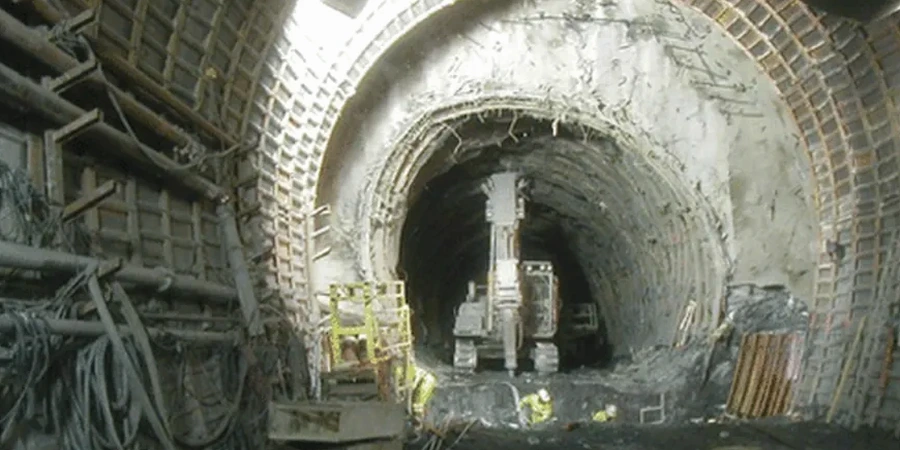
The biggest mistake we see with tunnel projects in Detroit is treating the glacial lakebed clays like ordinary stiff soil. They are not. These post-glacial deposits, underlying much of the metro area, exhibit high compressibility and time-dependent settlement that can wreck a tunnel lining within the first five years of operation. A standard site investigation misses the nuance. Our lab focuses on the consolidation behavior and undrained shear strength profile that actually governs face stability here. Before mobilizing a TBM, pairing your borehole program with a CPT test gives you a continuous stratigraphic profile that augments discrete samples, and when alignment runs near existing infrastructure, a deep excavation support analysis becomes non-negotiable to protect adjacent foundations.
Detroit's glacial lakebed clays behave more like a viscous fluid under sustained load than an elastic solid—if your tunnel lining design ignores secondary consolidation, you are under-designing for long-term ground load.
Quick answers
What is the typical cost for a geotechnical investigation for a soft ground tunnel in Detroit?
Why can't we just use SPT N-values for tunnel design in Detroit clay?
SPT N-values in Detroit's soft lakebed clays often fall below 4 blows per foot, which provides poor resolution for strength profiling. More importantly, SPT gives you a disturbed sample with no information on consolidation history or undrained stiffness. Tunnel face stability and settlement prediction require CIU triaxial data and oedometer-derived preconsolidation pressure—parameters an SPT alone cannot provide.
How do you handle the high groundwater table near the Detroit River for a tunnel alignment?
We install vibrating wire piezometers in multiple horizons to map the pore pressure profile with depth, then run constant-head permeability tests in the borehole to measure the coefficient of permeability directly. This data feeds a seepage model that defines the required face pressure for an EPB machine and the long-term buoyancy check on the lining.
What is the biggest driver of long-term settlement above a soft ground tunnel in Detroit?
Secondary consolidation, not primary. Detroit's plastic clays continue to compress for decades after pore pressures dissipate, due to particle reorientation. We measure the secondary compression index (Cα) directly in the oedometer and project settlement over a 50-year design life. Ignoring Cα can under-predict total settlement by 40 to 60 percent in these deposits.