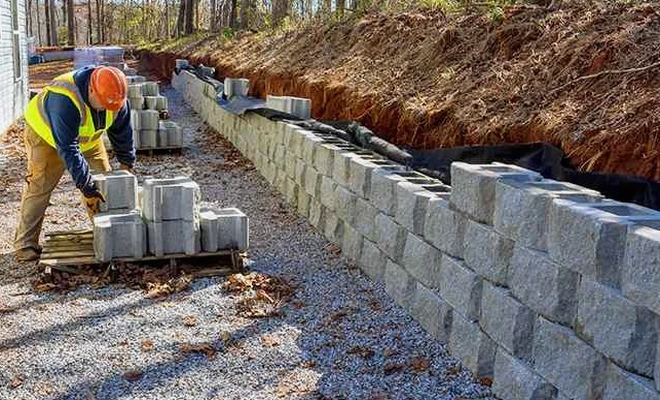
The 2015 Michigan Building Code, adopting IBC 2012 with Detroit-specific amendments, mandates a geotechnical investigation for any retaining structure exceeding 4 feet in height or supporting a surcharge. In Detroit, this requirement intersects with a subsurface profile dominated by Pleistocene lacustrine clays and silts deposited by glacial Lake Maumee, which can exhibit low undrained shear strength below 500 psf. Our team approaches each retaining wall design by first reconciling the structural demand with the site-specific stratigraphy, often integrating laboratory consolidation tests on Shelby tube samples to predict long-term settlement behind the wall stem. Before finalizing a cantilever or anchored solution, we typically correlate data from a Cone Penetration Test with adjacent borings to verify the consistency of the underlying glacial till, ensuring the bearing capacity assumptions hold across the entire wall alignment.
Assuming a friction angle of 30 degrees for Detroit's lacustrine clay without consolidated-undrained triaxial testing introduces a systematic error that compounds with every foot of retained height.
Local ground factors
The U.S. Geological Survey identifies a distinct band of artificial fill along the Detroit River waterfront, placed between 1880 and 1920 to expand industrial dockage. This fill, often containing slag, foundry sand, and demolition debris, can generate lateral pressures well in excess of those predicted by classical soil mechanics due to ongoing chemical weathering and internal erosion. For walls founded on or retaining such materials, we specify a minimum global factor of safety of 1.5 and require continuous excavation monitoring during construction to track any unanticipated deformation. Furthermore, the seasonal fluctuation of the groundwater table, which can rise to within 3 feet of the surface in spring, demands solid underdrainage design to prevent hydrostatic pressure buildup behind the wall face—a condition that has caused numerous historic failures in the city's older bulkhead structures.
Quick answers
What is the typical cost range for a retaining wall design package for a commercial project in Detroit?
How does the Detroit Building Code define when a retaining wall requires a permit and stamped engineering drawings?
Per the Michigan Building Code, which Detroit enforces, any retaining wall supporting more than 4 feet of unbalanced backfill, or any wall supporting a surcharge (such as a parking lot or structure), requires a permit and must be designed by a licensed professional engineer. The submitted package must include structural calculations for overturning, sliding, and bearing capacity, along with a geotechnical report establishing the allowable foundation pressure.
What geotechnical parameters are most critical for designing a retaining wall in Detroit's glacial clays?
The undrained shear strength (Su) from consolidated-undrained triaxial testing, the effective friction angle (φ') from direct shear or triaxial tests, and the coefficient of lateral earth pressure at rest (K0) are the controlling parameters. Detroit's overconsolidated clays can show K0 values exceeding 0.8, which generates at-rest pressures significantly higher than the active condition if the wall is not permitted to rotate. We also run swell-consolidation tests when backfill may be placed on the expansive upper crust of the lacustrine deposit.
What are the common failure modes you specifically check for in Detroit retaining wall designs?
We check for five primary failure modes: overturning about the toe, base sliding, bearing capacity failure of the foundation soil, deep-seated global slope instability (including through the underlying clay layer), and internal drainage failure leading to hydrostatic pressure buildup. For walls near the river, we also evaluate scour potential at the toe, and in filled areas, we assess the risk of internal erosion of the backfill through joint openings or weepholes.