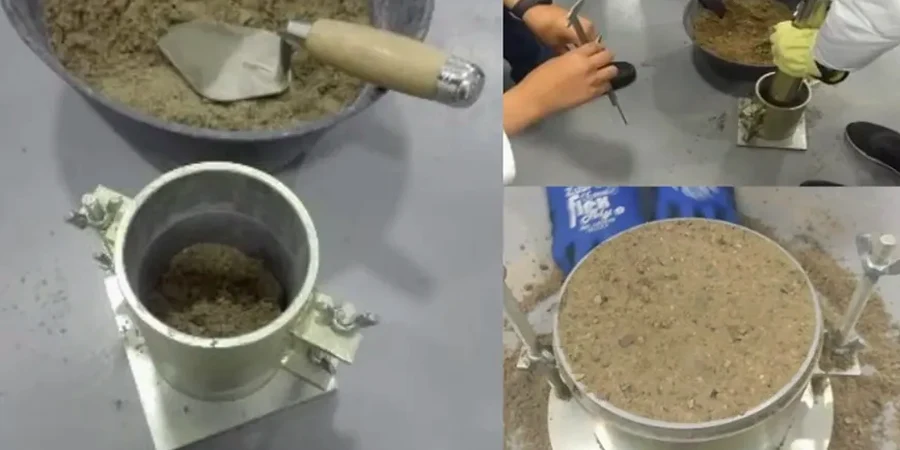
Detroit's subsurface is dominated by glacial lake plain deposits—layered silts, lean clays, and fine sands deposited by ancient Lake Maumee and Lake Whittlesey. These soils respond sharply to moisture change, which puts compaction control at the center of any earthwork spec. A Proctor test, whether Standard (ASTM D698) or Modified (ASTM D1557), establishes the relationship between moisture content and dry unit weight for a specific borrow material. Without that curve, a field density test with a nuclear gauge or sand cone has no reference target. Our lab runs the test on bulk samples taken directly from the site or from proposed borrow pits. We report maximum dry density and optimum moisture content, plus the zero-air-voids curve for full saturation reference. Detroit's seasonal groundwater fluctuates between 4 and 10 feet across much of Wayne County, and that shallow water table means fill lifts must be compacted on the dry side of optimum to avoid pore-pressure buildup.
A 2 percent deviation from optimum moisture can drop field density below 90 percent compaction on Detroit's lean glacial clays.
Process and scope
Michigan winters freeze the top 30 to 42 inches of ground, and the spring thaw turns the upper lift into saturated mush if compaction wasn't dialed in. The Modified Proctor (56,000 ft-lbf/ft³ compactive effort) typically yields a density 5 to 10 percent higher than the Standard method (12,400 ft-lbf/ft³), and the choice between them isn't arbitrary. MDOT specifications for roadway subbase call for Modified Proctor on aggregate base courses, while many commercial building pads in Oakland and Macomb counties still reference Standard Proctor for clayey structural fill. We run the test on material passing the No. 4 or 3/4-inch sieve, depending on gradation, and correct for oversize particles per ASTM D4718 when gravel content exceeds 5 percent. The lab compacts five or six points along the moisture spectrum—from dry of optimum to wet of optimum—and fits a well-defined compaction curve. Detroit clays with liquid limits above 40 often show a flat curve, which means the contractor has a narrow moisture window during placement.
Quick answers
What does a Proctor test cost in Detroit?
A single-point Standard or Modified Proctor test with the full moisture-density curve typically runs between US$90 and US$210 per sample, depending on whether oversize correction or one-point verification is included. Bulk discounts apply for projects with multiple borrow sources.
Which Proctor method does Detroit soil require—Standard or Modified?
The method depends on the specification, not the soil. MDOT and heavy structural projects normally require Modified Proctor per ASTM D1557. Residential and light commercial work often uses Standard Proctor per ASTM D698. We review the project geotechnical report and confirm the correct method before testing.
How long does a Proctor test take in the lab?
A full five-point or six-point compaction curve with oven moisture determinations takes 24 to 48 hours from sample receipt. Expedited service is available for projects on tight schedules. The one-point field check method using a previously established family of curves can provide same-day verification during active earthwork.
Can you run a Proctor on material with gravel or crushed concrete?
Yes. When the sample contains more than 5 percent oversize particles retained on the No. 4 or 3/4-inch sieve, we apply the ASTM D4718 correction to adjust the laboratory maximum dry density and optimum moisture content to field conditions. For recycled concrete aggregate common on Detroit brownfield sites, we also check for particle breakdown during compaction.