← Home · In-Situ Testing

Field Permeability Testing (Lefranc/Lugeon) in Detroit

Together, we solve the challenges of tomorrow.

LEARN MORE →

Assuming uniform drainage beneath a Detroit basement dig based on a single borehole log is a gamble. The city's stratigraphy is brutal for that assumption. Glacial lakebed sequences here interleave stiff clays with erratic sand and gravel lenses. Water flows where it wants. A Lefranc test in a clay layer tells you nothing about the sand channel two feet away. We run variable-head tests at multiple depths within the same boring. For bedrock, especially when assessing the Antrim Shale or underlying carbonates for tunnel work, we switch to Lugeon packer testing. You get a direct Lugeon value that defines grouting needs. No extrapolation. No guesswork. We also cross-check these results with grain size analysis to validate the hydraulic conductivity against Hazen correlations when dealing with coarser seams.

A single Lugeon test stage in Detroit's fractured bedrock reveals more about groundwater risk than a hundred grain-size analyses of the overlying clay.

Methodology and scope

ASTM D6391 governs packer test procedures for rock, but local application requires adapting to Detroit's specific overburden. The city sits on a paleo-lakebed. That means quick clay seams and desiccated crust zones. A Lefranc test performed too close to a desiccation crack will measure a meaningless high conductivity. Our field protocol mandates minimum 15-foot spacings from known fracture traces and pre-test saturation to eliminate air-bound false readings. We use pneumatic packers for Lugeon stages in fractured dolomite, running five pressure steps: low-high-low-high-low. This curve reveals turbulent flow, fracture dilation, or washout. Detroit's buried bedrock valleys are notorious for artesian conditions. Standard borehole permeability can miss this. A properly executed packer test isolates the zone and quantifies the risk before your excavation hits it. For deep shafts near the river, this data feeds directly into dewatering system design, often paired with deep excavation monitoring plans.
Field Permeability Testing (Lefranc/Lugeon) in Detroit
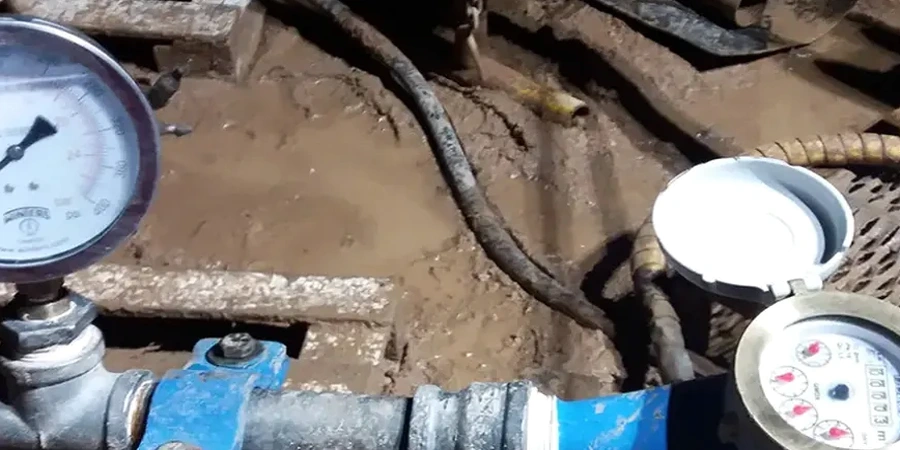
Technical reference image — Detroit

Local considerations

Detroit's freeze-thaw cycle and the proximity to the Detroit River create unique saturation dynamics. Spring thaw saturates the upper weathered crust, while deep artesian pressure persists year-round in the bedrock. Ignoring the Lugeon value in a dolomite layer can lead to a catastrophic base heave during excavation dewatering. We have seen Lugeon values jump from under 3 to over 30 between adjacent five-foot intervals. This heterogeneity defines the Detroit River Group. A Lefranc test in the overburden might show low permeability, giving a false sense of security. Meanwhile, a high Lugeon value 50 feet below signals a direct conduit to a regional aquifer. The risk is not just flooding. It is quick condition formation in the silt layers when upward gradients exceed critical values. Our testing sequence maps these gradients directly. This data prevents blowouts and ensures the safety of your crew.

Need a geotechnical assessment?

Reply within 24h.

Email: contact@geotechnicalengineering.biz

Technical parameters

ParameterTypical value
Test Standard (Rock)ASTM D6391-11
Test Method (Soil)Variable Head (Lefranc)
Applicable Soil TypesGlacial Tills, Lacustrine Clays, Silts
Applicable Rock TypesAntrim Shale, Detroit River Group Carbonates
Packer TypePneumatic Single/Double Packer
Pressure Stages (Lugeon)5-stage (L-H-L-H-L)
Measurement Range1x10^-7 to 1x10^-2 cm/s
Primary OutputLugeon Value / Hydraulic Conductivity (k)

Associated technical services

01

Lefranc Variable Head Tests

In-situ hydraulic conductivity measurement in glacial clays and silts. We isolate specific strata using inflatable packers to prevent cross-contamination between aquifers and aquitards.

02

Lugeon Packer Tests

Five-stage pressure testing in fractured bedrock using pneumatic packers. We quantify fracture permeability to define grout curtain specifications for deep excavations and shafts.

03

Dewatering Feasibility Analysis

Translation of field k-values into practical dewatering schemes. We calculate well spacing, radius of influence, and expected drawdown to optimize pump sizing for Detroit's layered geology.

Applicable standards

ASTM D6391-11 (Rock Mass Permeability), ASTM D5084 (Flexible Wall Permeameter for Lab Correlation), IBC 2024 Section 1803 (Geotechnical Investigations), USBR Earth Manual Part 2

Frequently asked questions

What is the difference between a Lefranc test and a Lugeon test in Detroit applications?

A Lefranc test measures hydraulic conductivity in soil by adding or removing water from an open borehole section. It works well in Detroit's clay and silt overburden. A Lugeon test uses a packer to isolate a specific rock interval and injects water under pressure. We use Lugeon for fractured bedrock like the Antrim Shale or Detroit River Group carbonates. Lugeon gives a direct measure of fracture flow, while Lefranc gives bulk soil permeability.

How much does a field permeability test package cost in Detroit?

A typical Lefranc/Lugeon testing program in Detroit ranges from US$580 to US$900 per test interval, depending on depth, overburden conditions, and whether a single or double packer setup is required. Mobilization costs are separate and depend on site access and distance from our Detroit equipment yard.

Why are Lugeon values so variable in the Detroit River Group bedrock?

The Detroit River Group contains evaporite solution breccias and fractured dolomite. Gypsum dissolution creates unpredictable cavities and high-permeability channels. A Lugeon value can change from tight (under 1 Lugeon) to highly permeable (over 20 Lugeon) within a few vertical feet. That is why we run a full five-stage pressure test to map fracture dilation and washout behavior, not just a single-point measurement.

Can you combine permeability testing with SPT drilling in Detroit?

Yes. We typically advance the borehole using SPT methods to log stratigraphy, then install a temporary casing to perform Lefranc tests at target depths in the soil. Once bedrock is encountered, we core the rock and run Lugeon packer tests in the same hole. This minimizes mobilization costs and gives you a complete geotechnical profile from one setup.
Location and service area

We serve projects across Detroit and surrounding areas.

View larger map