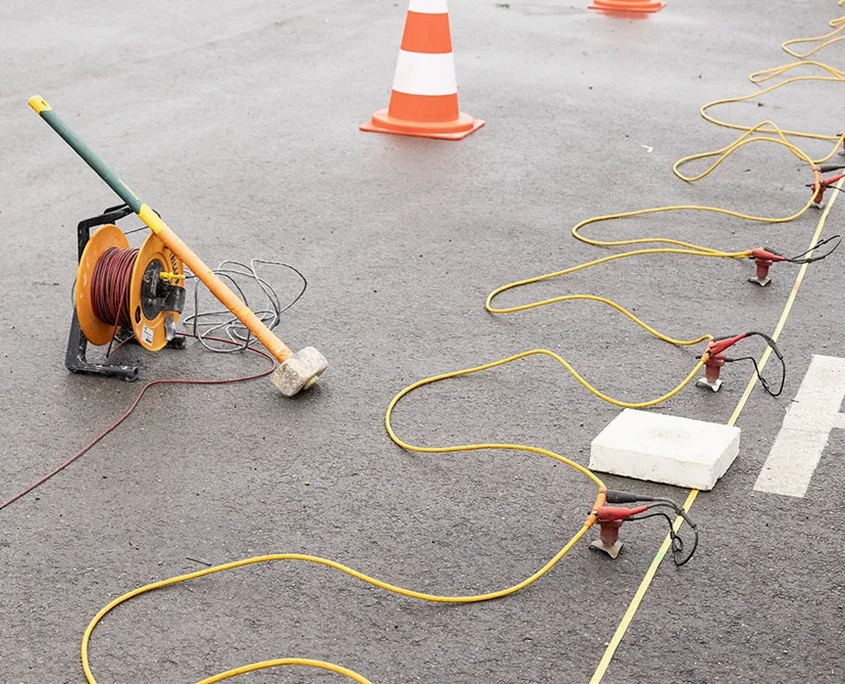
Detroit's subsurface tells a story of ancient seas, glacial advances, and industrial transformation. Beneath the city streets, 30 to 60 meters of glacial till and lacustrine clay blanket Paleozoic bedrock—limestone and dolostone of the Detroit River Group. This layered stratigraphy creates specific challenges for geotechnical investigation. Standard borings sample a single point. Seismic tomography, by contrast, images the continuous profile between source and receiver, revealing hidden velocity anomalies that drilling alone might miss. The technique proves particularly valuable where the bedrock surface is irregular or where dissolution features within the carbonate sequence pose karst risk. For deep foundation design near the Detroit River, combining tomographic profiles with SPT drilling data gives us both velocity structure and penetration resistance, a pairing that reduces uncertainty in bearing capacity estimates.
In Detroit's glacial terrain, the velocity contrast between saturated clay fill and limestone bedrock can exceed a factor of three. Tomographic inversion captures that interface where single-point methods interpolate blindly.
Process and scope
The contrast between downtown Detroit and the outlying suburbs illustrates how depositional history shapes seismic response. Near the Renaissance Center, thick glaciolacustrine clays overlie limestone at variable depth; velocity contrasts between the soft clay fill and competent bedrock are sharp, often exceeding 1200 m/s. Out toward Livonia, the drift thins and the bedrock rises closer to grade, with a more gradual velocity gradient. A single survey methodology rarely fits both settings. In the urban core, we favor high-resolution reflection profiling to map bedrock topography beneath fill and old foundations, while in the western suburbs, refraction tomography often suffices for rippability assessment and depth-to-rock mapping. When dissolution cavities are suspected—and they are, throughout the Detroit River Group limestone—crosshole or downhole surveys tied to
resistivity imaging help differentiate air-filled voids from clay-infilled depressions. For brownfield redevelopment sites, where undocumented fill and buried structures complicate the near-surface, we also integrate
MASW to constrain shear-wave velocity profiles for site classification under ASCE 7.
Local ground factors
A common mistake on Detroit brownfield projects is to rely on historical records and widely spaced borings to characterize subsurface conditions, then proceed with foundation design without geophysical imaging. The problem is that buried demolition debris, old basements, and irregular bedrock—all common across the city—create lateral variability that borings alone cannot resolve. We have seen projects where undetected dissolution zones in the Detroit River Group limestone required costly foundation redesign after excavation revealed conditions that a seismic tomography line would have flagged early. Another frequent oversight is neglecting the effect of saturated fill on wave propagation: low-velocity zones can mask deeper reflectors, leading to misinterpretation of bedrock depth. A properly parameterized tomographic survey, processed with ray-tracing or full-waveform inversion, mitigates these risks by mapping velocity gradients continuously across the site.
Quick answers
How deep can seismic refraction and reflection surveys investigate in Detroit's geology?
Refraction surveys in the Detroit area typically image to depths of 15 to 40 meters, depending on the spread length and the energy source used. Reflection surveys can reach considerably deeper—anywhere from 30 to over 200 meters—which is sufficient to map the full thickness of glacial drift and characterize the underlying Detroit River Group limestone and the Sylvania Sandstone below it. The actual penetration depth on any given site depends on the velocity structure, ambient noise levels, and the source energy permitted under urban working constraints.
What is the typical cost range for a seismic tomography survey in Detroit?
Can seismic tomography identify karst cavities in the Detroit River Group limestone?
Yes, seismic tomography is one of the most effective geophysical tools for detecting dissolution features in carbonate bedrock. In the Detroit River Group limestone that underlies much of the city, air-filled or clay-infilled cavities appear as localized low-velocity anomalies within the otherwise high-velocity limestone. The resolution depends on cavity size relative to receiver spacing. For small features, combining tomographic profiles with electrical resistivity imaging improves detection confidence, since air-filled voids present as high-resistivity targets while clay-filled ones show low resistivity.
How long does a seismic survey take on a typical Detroit site?
Field acquisition for a typical two- to three-line refraction survey on a Detroit site usually takes one to two days, assuming standard urban logistics are in place. Reflection surveys with tighter receiver spacing and higher fold may extend to three or four field days. Processing and interpretation add another week to ten days, depending on the complexity of the velocity model and the deliverables required. We schedule fieldwork around weather windows—frozen ground in winter can actually improve coupling and reduce surface-wave noise, while saturated summer soils may require different source parameters.
What deliverables do you provide from a seismic tomography investigation?
Our standard deliverables include 2D P-wave velocity tomograms with annotated geologic interpretation, depth-to-bedrock contour maps where multiple lines are acquired, a processed velocity model in digital format compatible with CAD or GIS platforms, and a comprehensive report documenting acquisition parameters, processing workflow, and geotechnical recommendations. For sites requiring seismic site classification under ASCE 7, we supply Vs30 estimates derived from the velocity model. All reports are stamped by a licensed professional engineer familiar with Michigan subsurface conditions.