Detroit’s glacial lake plain geology hides a lot more than clay. The ancient shorelines of Lake Maumee left behind laminated silts, buried organics, and pockets of sand that standard borings often miss. An exploratory test pit opens the ground visually so the geotechnical engineer can log the actual stratification, sample the material in place, and catch lenses of compressible soil before they turn into differential settlement claims. In a city where fill thickness varies from 2 to 12 feet depending on how many times a parcel was backfilled since the 1920s, direct observation beats indirect inference every time. We mobilize a compact excavator or backhoe, clear utilities through MISS DIG 811, and log the exposed profile per ASTM D2488 with a field geologist on the bucket. The work fits tight urban lots in Corktown just as well as the wide-open commercial pads along Eight Mile, and it pairs naturally with in-situ permeability tests when infiltration is part of the stormwater plan.
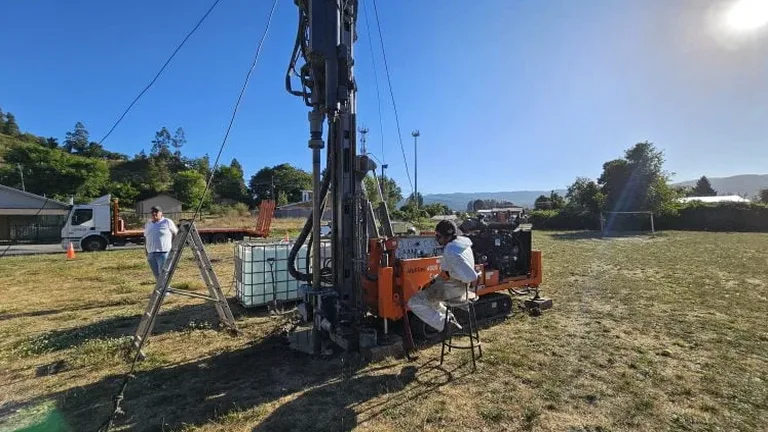
An open test pit in Detroit’s glacial lake plain reveals seams of soft organic silt that a 2-inch split spoon will never capture.
Process and scope
A common misstep we see with small contractors is assuming that a single soil boring is enough to characterize a site. In Detroit’s mixed fill, that bet backfires fast. The east side sits on a dense clay till, while the west side runs into loose granular fill over desiccated crust, and a single SPT borehole won’t reveal the lateral extent of a buried concrete slab or an old brick-lined cesspool. Our exploratory test pit work follows a systematic protocol: the pit is excavated to 12–14 feet or refusal, the walls are cleaned with a flat bucket, and the geologist logs soil color, moisture, consistency, and structure in natural light. We collect bulk samples for lab index testing and, when needed, extract undisturbed blocks for strength analysis. Because Detroit’s water table sits shallow—often within 5 feet of grade in spring—we also document seepage inflow and run simple percolation checks on the pit floor. The field log becomes the backbone of the geotechnical report, and it’s cross-checked with lab data from our ISO 17025-accredited soil laboratory. For sites where the city requires infiltration credit, the open pit doubles as a test basin for a falling-head permeability trial before backfill.
Local ground factors
A project in Midtown and one in Delray can sit less than four miles apart and encounter completely different risk profiles. Midtown’s glacial till is stiff, overconsolidated, and drains poorly; Delray’s industrial fill sits on wet alluvium with pockets of slag, wood debris, and hydrocarbon-stained soil. Skipping exploratory test pits in either location invites surprises during excavation—hitting a buried foundation, triggering a slope failure at the property line, or discovering contaminated soil after the footing trenches are open. Detroit’s building department reviews rely on IBC Chapter 18 and ASCE 7, and they expect site-specific soil data when the design professional calls for it. An open pit also gives the structural engineer a direct look at the bearing stratum, which is invaluable when shallow foundations are being considered on marginal ground. If the pit reveals uncontrolled fill thicker than anticipated, the team can pivot to deep foundations or ground improvement before the concrete is ordered, not after.
Quick answers
How much does an exploratory test pit cost in Detroit?
For a standard test pit up to 12 feet deep, including MISS DIG clearance, excavator mobilization, field logging, and a brief summary report, the cost typically runs between US$550 and US$900. The final figure depends on access conditions, the number of pits, and whether lab testing or extended infiltration trials are added to the scope.
How deep can you go with a test pit in Detroit’s soil?
With a compact excavator, we routinely reach 12 to 14 feet before encountering refusal or groundwater that complicates wall stability. Deeper excavation is possible using shoring or a benched slope, but at that point a drill rig for SPT sampling is usually more practical and we help clients decide the right cutoff.
Do you need a permit for a test pit in Detroit?
A city right-of-way permit is required if the pit is in the sidewalk or street. On private property, no separate city permit is needed for the excavation itself, but we always file a MISS DIG 811 ticket and coordinate with any private utility locators before breaking ground.