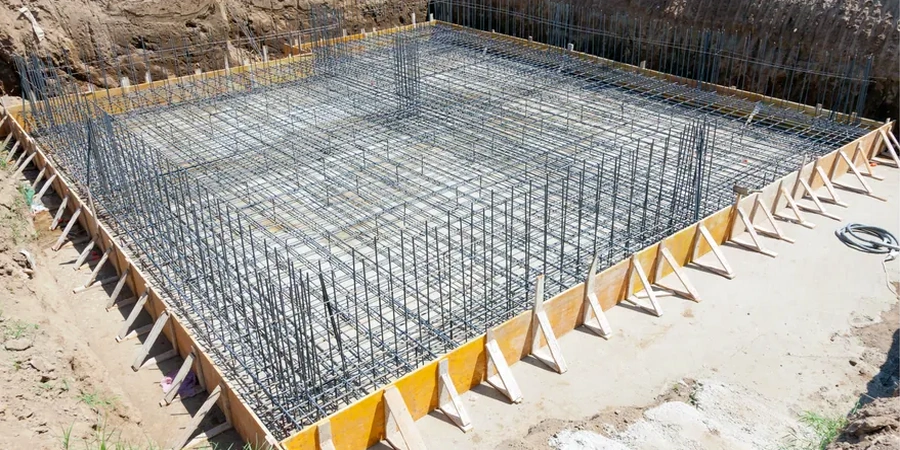
Detroit sits on a deep sequence of glacial lake plain deposits—clays and silts that look stiff at the surface but compress significantly under sustained load. We've seen projects near the Riverfront where a 10-story building on isolated footings showed measurable tilt within three years, simply because the underlying clay varied in thickness by six feet across the site. A raft foundation spreads the structural load across a much larger footprint, reducing the intensity on any single point and evening out differential settlement. Our approach to mat foundations always starts with a detailed stratigraphic profile—without it, you're guessing at compressibility layers. When the soil profile shows interbedded sand lenses, we often pair the raft analysis with SPT drilling to verify refusal depths and confirm whether end-bearing piles would actually be more economical than a thick mat.
On Detroit's glacial lake plain, raft thickness is governed more by consolidation settlement than by bearing capacity—ignore the compression index and you'll be chasing cracks in the partition walls within two years.
Local ground factors
A mid-rise residential project on Woodward Avenue taught us a hard lesson about raft foundations on Detroit's clays. The geotech report identified a desiccated crust—stiff, fissured clay down to about 3 meters—and the structural engineer designed the mat assuming that stiffness continued to depth. It didn't. Below the crust, the normally consolidated clay was much softer, and the raft experienced post-construction settlement that exceeded predictions by nearly 40 percent. The fix involved underpinning with micropiles, which cost the developer more than if we had run a full consolidation analysis from the start. The real risk in this city isn't total settlement; it's differential settlement where the clay thickness changes abruptly, like near buried river channels or old industrial fill boundaries. We always recommend at least two deep borings with undisturbed sampling, plus CPT soundings to catch those transitions. Without that data, even a well-reinforced mat can tilt enough to bind elevator rails and crack utility connections at the property line.
Quick answers
When is a raft foundation better than individual footings in Detroit?
When the allowable bearing pressure drops below about 100 kPa or when the total area of isolated footings would exceed 50% of the building footprint. Detroit's compressible clays often make isolated footings uneconomical because you'd need them so large they'd nearly touch anyway. A raft also handles differential settlement better—critical where clay thickness varies across the site.
What does a raft foundation design and soil investigation cost for a typical Detroit project?
For a standard commercial or mid-rise residential project in Detroit, you're looking at roughly US$1,120 to US$4,200 for the geotechnical investigation and raft design package. The range depends on number of borings, consolidation testing requirements, and whether CPT soundings are included. A full finite element settlement model adds to the upper end but saves multiples of that in avoided post-construction repairs.
How do you determine if Detroit's clay is normally consolidated or overconsolidated?
We run one-dimensional consolidation tests and plot e-log p curves. The preconsolidation pressure (using Casagrande's graphical method) tells us if the clay has been preloaded by glacial ice or desiccation. Detroit clays are often lightly overconsolidated in the upper 3–5 meters due to desiccation and water table fluctuation, then normally consolidated below that. That transition depth is critical for settlement calculations.
How long does consolidation settlement take under a raft in Detroit?
Primary consolidation in Detroit's clays typically completes in 2 to 5 years for a mat 15–20 meters wide, assuming double drainage to sand lenses above and below the clay layer. Secondary compression continues at a much slower rate. We calculate time-rate curves from the coefficient of consolidation (cv) measured in the lab, and if the schedule demands faster stabilization, we evaluate prefabricated vertical drains or surcharging to accelerate the process.